Structured data
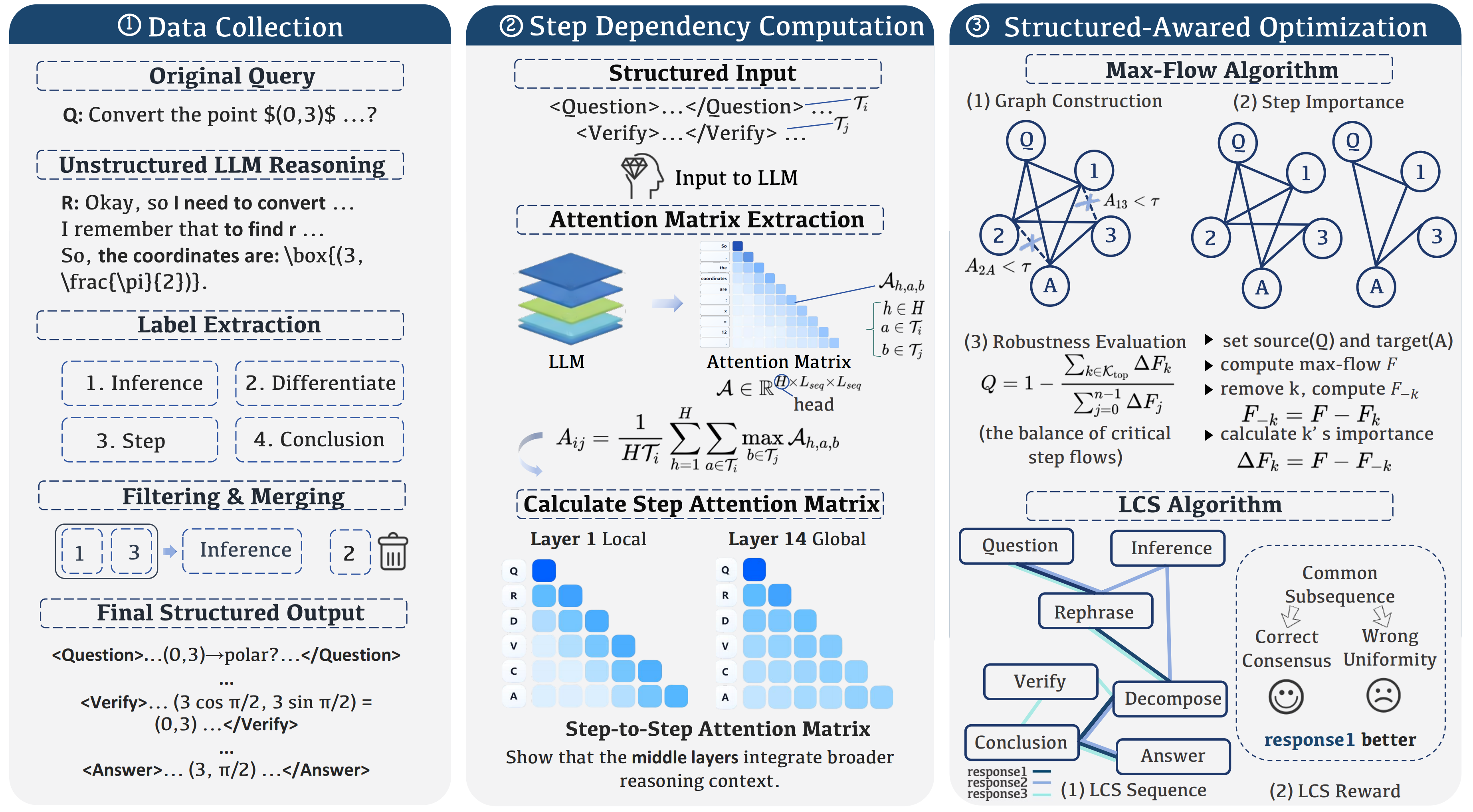
Organize teacher-generated reasoning into cognitive steps using a shared vocabulary of 23 tags, enabling consistent step extraction.
A unified framework for efficiency and explainability.
Make reasoning steps explicit. Trace their dependencies.
Optimize the paths that lead to an answer.
College of Computer Science and Technology, Zhejiang University
An illustrative step sequence. Dependencies are analyzed separately using model attention.
Structured Reasoning combines step-annotated training data, layer-wise dependency analysis, and structure-aware reinforcement learning. It studies how a model can reach answers with more efficient, stable, and interpretable reasoning.
Organize teacher-generated reasoning into cognitive steps using a shared vocabulary of 23 tags, enabling consistent step extraction.
Aggregate model attention into step-to-step relationships and inspect how information flows across layers.
Use complementary rewards to assess step contributions and align reasoning with reliable reference paths.
Open the existing research demonstration to inspect step attention and compare MaxFlow, TopK, and TopP pruning on example reasoning graphs.
Yubo Dong, Hehe Fan, Linchao Zhu, and Yi Yang
The original preprint was titled “Enhancing Large Language Models through Structured Reasoning.” The conference version uses the title and author list shown above.
One complete training split with problem statements, tagged reasoning, answer targets, and ordered step annotations. Available in Parquet and JSONL.
problem_id — stable identifierproblem — questionreasoning — paired step tags and reasoninganswer — answer targetcontent — final responsesteps — step ID, type, and textfrom datasets import load_dataset
dataset = load_dataset(
"FreeFrank/Structured-Reasoning",
split="train",
)
example = dataset[0]
print(example["reasoning"])For reasoning-supervised training, retain both the reasoning and final answer in the assistant target. Check context lengths with your model’s tokenizer; a 32k context accommodates the checked serialization.
This is a curated release with editorial curation and step annotations. It is not claimed to be the exact experimental corpus from the paper. The dataset card documents provenance and limitations; no independent corpus-wide accuracy estimate is reported. Attention weights and dependency graph edges are not included in this text dataset.
The first code release is available now alongside the paper, dataset, and research demo. It provides structured SFT, reusable MaxFlow/LCS kernels, and evaluation analysis tools.
Conference paper, project overview, citation, and resource links.
516 annotated examples on Hugging Face and the step-dependency visualization.
Structured SFT, cognitive-step parsing, and tested MaxFlow/LCS reward kernels.
Command-line tools for LightEval aggregation, tag usage, trace length, and malformed-output analysis.
The instrumented attention extractor, distributed experiment launcher, weights, and model cards remain in preparation.
The code is released under MIT. Dataset licensing and provenance are documented on its Hugging Face card. Exact paper reproduction still depends on components listed in the public roadmap.
@inproceedings{dong2026structuredreasoning,
  title = {Structured Reasoning for LLMs: A Unified Framework
           for Efficiency and Explainability},
  author = {Dong, Yubo and Fan, Hehe and Zhu, Linchao and Yang, Yi},
  booktitle = {International Conference on Learning Representations},
  year = {2026},
  url = {https://proceedings.iclr.cc/paper_files/paper/2026/hash/ad5b3f324b24c17cdc2f3712298c76bd-Abstract-Conference.html}
}