Structured data
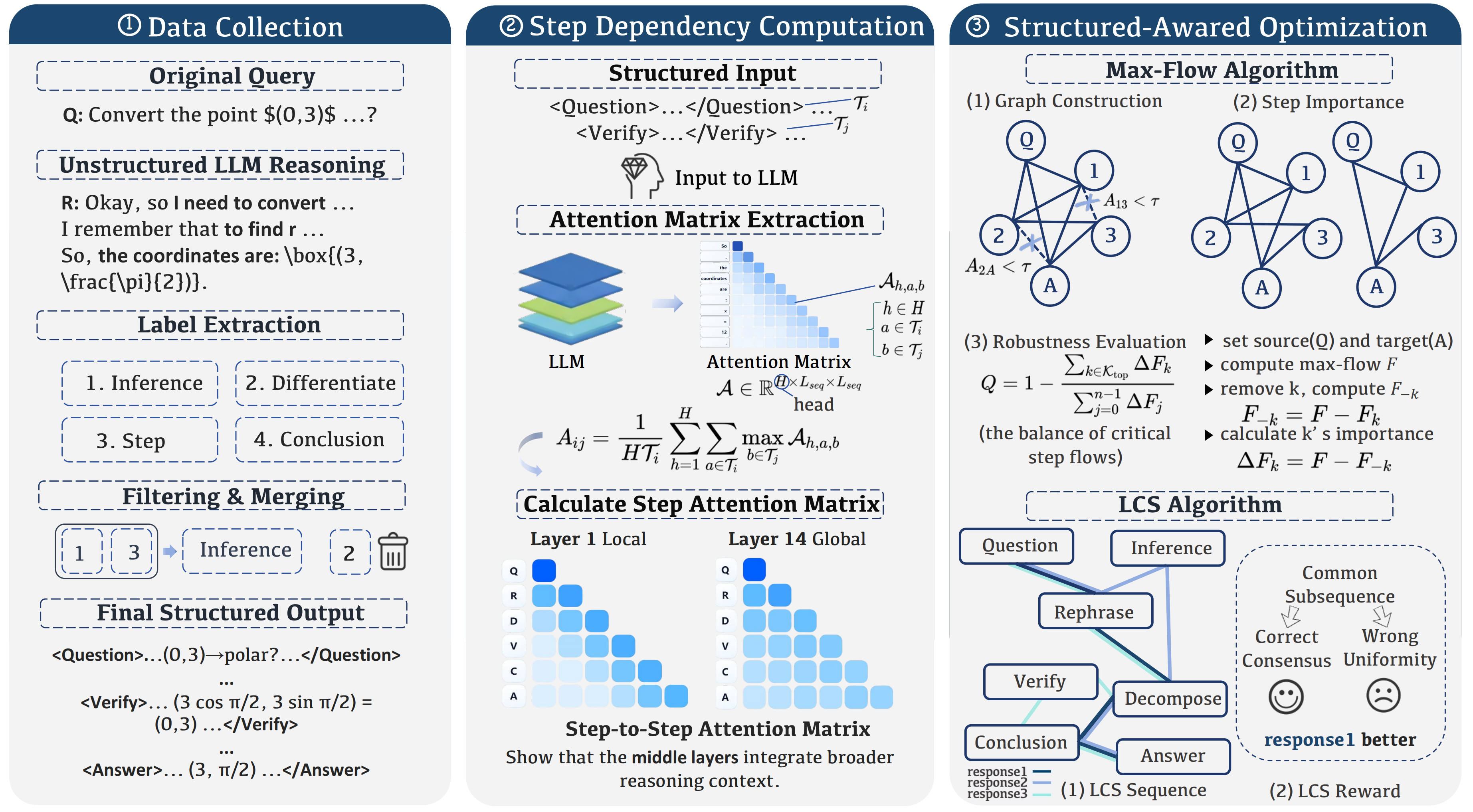
Organize teacher-generated reasoning into cognitive steps using a shared vocabulary of 23 tags, enabling consistent step extraction.
A unified framework for efficiency and explainability.
Make reasoning steps explicit. Trace their dependencies.
Optimize the paths that lead to an answer.
College of Computer Science and Technology, Zhejiang University
An illustrative step sequence. Dependencies are analyzed separately using model attention.
Structured Reasoning combines step-annotated training data, layer-wise dependency analysis, and structure-aware reinforcement learning. It studies how a model can reach answers with more efficient, stable, and interpretable reasoning.
Organize teacher-generated reasoning into cognitive steps using a shared vocabulary of 23 tags, enabling consistent step extraction.
Aggregate model attention into step-to-step relationships and inspect how information flows across layers.
Use complementary rewards to assess step contributions and align reasoning with reliable reference paths.
Open the existing research demonstration to inspect step attention and compare MaxFlow, TopK, and TopP pruning on example reasoning graphs.
Yubo Dong, Hehe Fan, Linchao Zhu, and Yi Yang
The original preprint was titled “Enhancing Large Language Models through Structured Reasoning.” The conference version uses the title and author list shown above.
One complete training split with problem statements, tagged reasoning, answer targets, and ordered step annotations. Available in Parquet and JSONL.
problem_id — stable identifierproblem — questionreasoning — paired step tags and reasoninganswer — answer targetcontent — final responsesteps — step ID, type, and textfrom datasets import load_dataset
dataset = load_dataset(
"FreeFrank/Structured-Reasoning",
split="train",
)
example = dataset[0]
print(example["reasoning"])For reasoning-supervised training, retain both the reasoning and final answer in the assistant target. Check context lengths with your model’s tokenizer; a 32k context accommodates the checked serialization.
This is a curated release with editorial curation and step annotations. It is not claimed to be the exact experimental corpus from the paper. The dataset card documents provenance and limitations; no independent corpus-wide accuracy estimate is reported. Attention weights and dependency graph edges are not included in this text dataset.
The paper, dataset, and research demo are available now. The remaining releases are planned in stages; dates will be announced in the main repository.
Conference paper, project overview, citation, and resource links.
516 annotated examples on Hugging Face and the existing step-dependency visualization.
Planned: annotation and validation utilities, structured SFT, and MaxFlow/LCS reward implementations.
Planned: environment setup, experiment configurations, evaluation scripts, and instructions for reproducing reported comparisons.
Planned: model weights, model cards, and inference examples. Release timing and licensing are to be announced.
The dataset’s MIT license applies to the dataset release. Licenses for forthcoming code and checkpoints will be specified when those artifacts are published. This roadmap describes intended scope rather than a committed release date.
@inproceedings{dong2026structuredreasoning,
  title = {Structured Reasoning for LLMs: A Unified Framework
           for Efficiency and Explainability},
  author = {Dong, Yubo and Fan, Hehe and Zhu, Linchao and Yang, Yi},
  booktitle = {International Conference on Learning Representations},
  year = {2026},
  url = {https://proceedings.iclr.cc/paper_files/paper/2026/hash/ad5b3f324b24c17cdc2f3712298c76bd-Abstract-Conference.html}
}